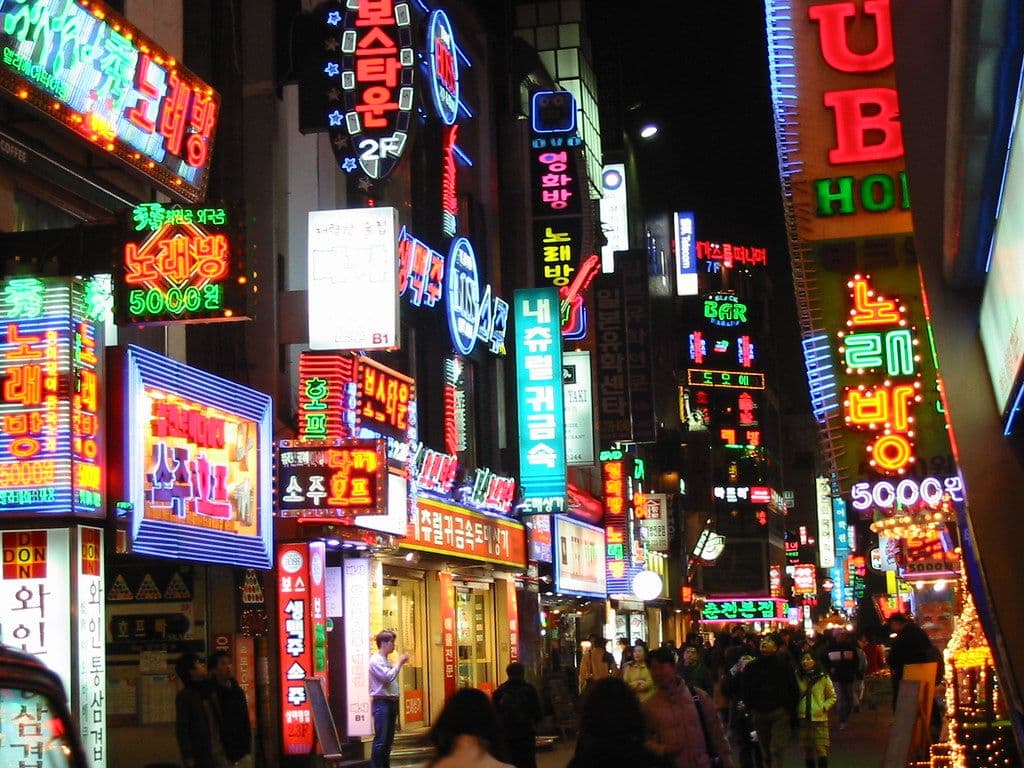
Four in the morning, and the lights are on
Walk through a busy Korean district at four in the morning and the first thing you register is that the street is not asleep. A café is open with people at tables, some of them working. A restaurant is serving a group who have clearly been somewhere else first. Up a narrow stairwell, a backlit sign advertises a PC bang, and through the window you can see rows of screens and the tops of heads.
None of this has the atmosphere of a place hanging on until dawn. It has the atmosphere of a place that is simply open, staffed and busy, at an hour when the visitor's own city has been dark for five hours.
The night stops being a wall
Most people have an internal map of the day with a hard edge in it. After a certain hour, the options collapse: go home, or go to a bar, and once the bars close, go home. The edge is so consistent where they come from that they treat it as a property of time rather than of local licensing and labour markets.
Visitors describe the removal of that edge as the disorienting part. An evening that would have ended at eleven does not end. A conversation that would have been cut short by the venue closing runs on somewhere else. People find themselves in a café at 2am not because they are night owls but because the café was there and the conversation was not finished.
For visitors arriving with jet lag, the effect is more concrete. Being awake at four in the morning in most cities is a miserable experience of waiting for something to open. Here it is simply an hour, with places in it.
And then there is the study café and the PC bang, which serve a purpose visitors often misread at first. These are not entertainment venues that happen to be open late. They are, functionally, rooms — quiet rooms with desks, or loud rooms with fast machines — rented by the hour to people who do not have enough room at home.
Why the city runs this way
Demand comes from how the day is structured. Korean working and studying hours run long and often finish late, and what follows work then starts late. If a substantial share of the population is finishing at ten, then eleven is early evening rather than the end of it. The businesses that stay open are not creating that demand; they are the second half of a schedule that begins later than the visitor's.
Rent is spread over more hours. Commercial rent in dense Korean districts is high and is paid whether or not the lights are on. A business that can generate any revenue between midnight and six is diluting a fixed cost. This is the plainest reason and it applies most obviously to the venues with high fixed capital, like the machine-filled rooms.
Drinking runs in stages. The convention is to move — a meal, then a second place, then a third, each with its own type of venue. A culture of moving between venues over a long evening requires that there be venues to move to at each hour, and it sustains a chain of businesses whose peak trade is at a time when other countries' restaurants are cashing up.
Homes are small and shared. A studio apartment or a family flat with several adults in it does not offer a place to study, or to play loudly with friends, or to sit with someone for three hours. The rented room — desk, screen, drink included — is the overflow space for domestic life, and overflow space is needed at exactly the hours when home is most crowded or most inadequate.
The night is low-friction. Being out at 3am here carries little of the risk calculation it carries in many cities, which removes a constraint that elsewhere closes venues from the demand side rather than the supply side.
What this is not
It is shrinking, and anyone describing this in the present tense should say so. Labour costs have risen, overnight staffing is expensive, and a great many businesses that once ran continuously now close for part of the night. The 4am city of a decade ago was denser than today's.
It is also concentrated. A handful of districts in the largest cities carry most of this, and a residential neighbourhood twenty minutes away is as closed at 2am as anywhere else. "Open at 4am" is true of specific streets, not of the country.
And there is a version of this that flatters Korea in a way Koreans would not. The long night is downstream of long working hours, long study hours, competitive schooling, cramped housing and a drinking culture that people here have complicated feelings about. Ask locals and a fair number will describe the 24-hour city as a symptom rather than an amenity. Both readings are true at once, and the visitor generally only sees the pleasant one.
Why it lands as a surprise
The surprise is not that a few places are open late. Every city has something open late — a diner, a club, a taxi stand. The surprise is that the ordinary options remain available. Not a special place for late-night people, but the same café you would have gone to at three in the afternoon, still doing normal business at three in the morning.
That distinction matters because it is what makes the night feel continuous rather than exceptional. In most cities, staying out late means entering a different city with different rules, populated by a different set of people. Here it mostly means the same city, with fewer people in it.
Which is also why the reaction depends so heavily on where someone is from. A visitor from a city with its own long night registers a difference of degree. A visitor from somewhere that closes at eleven walks past a lit café at four and experiences something closer to a small structural confusion — the sense that a boundary they had always treated as part of the world turns out to have been a local arrangement all along.