Dinner arrives on the grass
A summer evening on the Han River. People are sitting on mats on the grass, well away from any building, a few hundred metres from the nearest road. Someone orders fried chicken. Half an hour later a rider parks, walks out across the lawn carrying a bag, finds the right group, hands it over and leaves.
The part that stops visitors is not the speed. It is that the order had a destination at all. There is no address on a lawn. But the lamp posts along the riverside parks are numbered, and the number is the address, and the whole system — the rider, the app, the restaurant — treats a patch of grass as a place you can send food to.
The threshold collapses
Everyone has a mental threshold below which ordering food is not worth it. It is made of waiting time, minimum spend, and the small social cost of making someone come to you. In Korea that threshold drops so far that people stop noticing it exists.
Visitors describe ordering things they would never order at home. A single coffee. One portion of something, at eleven at night, because they wanted it. Breakfast. A dessert, separately, after the meal has already arrived. The change is not that delivery is available — it is available everywhere now — but that it stops being an event. It becomes as unremarkable as walking to the kitchen.
The second change is about location. At home, delivery goes to your home. Here it goes to a park, a riverbank, a hotel lobby, a rented studio you have been in for two days. Visitors report a specific moment of recalibration when they understand that "where you are" is a valid answer to "where should we send it".
The third is timing. When arrival is reliably fast, you stop ordering in advance. You order when you are hungry, which sounds trivial and is in fact a different way of running an evening.
Why it is this fast
Vertical density does most of the work. A rider carrying several orders at once may deliver all of them within one building, or within a block of buildings, without ever moving far. The economics of delivery are governed by drops per hour, and stacking a residential tower with hundreds of households on one lift shaft is the most efficient delivery environment anyone has ever built. Distance is the enemy of delivery, and Korean cities have very little of it.
There is a mature market for the riding itself. Delivery is dispatched through platforms that price each drop, and riders take work from more than one source at a time. That produces a large, liquid, always-on supply of riders who can be matched to an order within seconds. The dispatch is not a favour from the restaurant; it is a separate industry.
Restaurants are built for it. Packaging, portioning and kitchen layout assume that a substantial share of orders will leave the building. Some kitchens exist only to serve delivery and have no dining room at all. When a restaurant is designed around the outbound bag rather than the table, the handover takes seconds instead of minutes.
Addressing works. This is the least visible ingredient and possibly the most important. The system has usable coordinates for places that are not buildings — park zones, numbered posts, specific entrances of specific towers. A delivery network can only be as precise as its addresses, and precision is what removes the last ten minutes of every delivery, the ones spent standing outside making a call.
What this is not
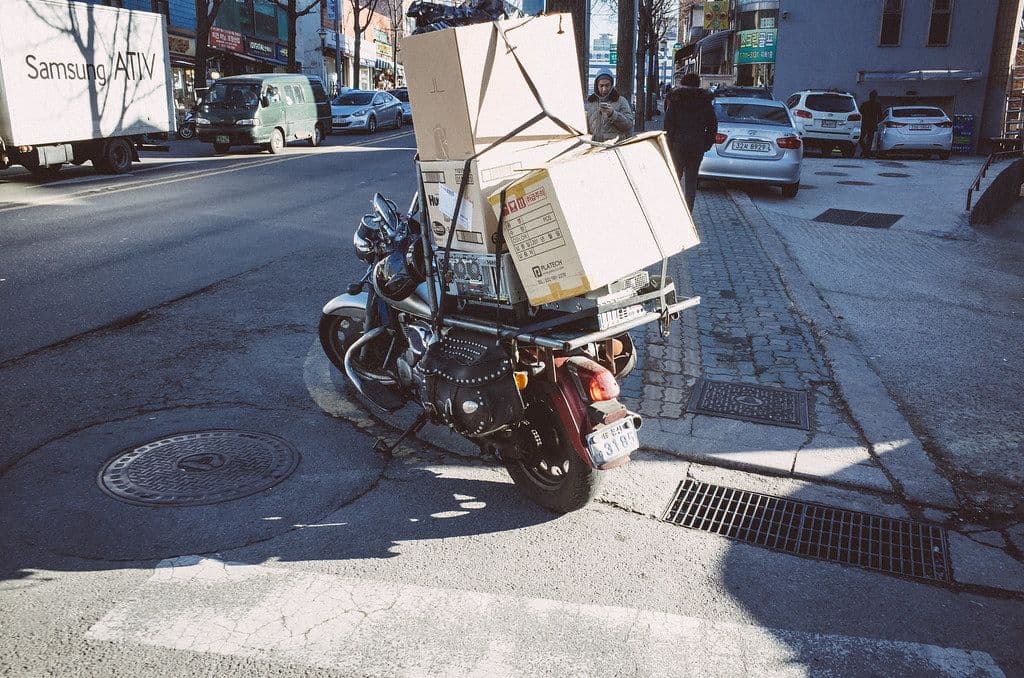
Speed is not free, and it is not magic. It is a person on a two-wheeler moving quickly through traffic in whatever weather is happening, paid per completed drop, in a job where going faster pays more. Rider injury is a live public issue here, and Koreans discuss it more than visitors do. A visitor who describes the system as delightful without noticing the labour underneath it is only seeing the customer's half.
The fees are also real and have risen. Delivery charges, platform charges and minimum orders sit between the price on the menu and the price you pay, and Korean households complain about this at some length. "Cheap" is not the claim; "fast and available" is.
Nor does everything arrive well under an hour. Peak evening hours, bad weather and popular restaurants all stretch the wait, sometimes considerably, and the same conditions that produce twenty-minute delivery on a Tuesday produce ninety-minute delivery on a rainy Friday. Food that travels badly still travels badly. And the packaging volume that all of this generates is a recognised problem rather than an unnoticed one.
Why it lands as a surprise
Delivery exists in every country the visitor came from, which is precisely why the surprise is sharper than it would be for something wholly unfamiliar. There is no novelty to absorb the shock. The category is known, the object is known, and only the parameters have moved — which makes the change feel less like a new experience and more like a rule quietly breaking.
What actually gets violated is a set of unstated limits: that food goes to addresses, that a small order is not worth placing, that you should decide what you want in advance. None of those were ever laws. They were consequences of how far apart things are and how the labour is organised where the visitor lives. Change the density and the dispatch, and the limits dissolve without anyone announcing it.
That is also why the same riverside scene reads so differently to different people. A visitor from a dense city with its own delivery culture sees a marginal improvement. A visitor from somewhere low-rise and spread out watches a bag of food walk across a lawn and cannot immediately explain to themselves why it feels impossible. Nothing impossible happened. Their baseline was set by a city built at a different scale, and they never had cause to examine it until now.