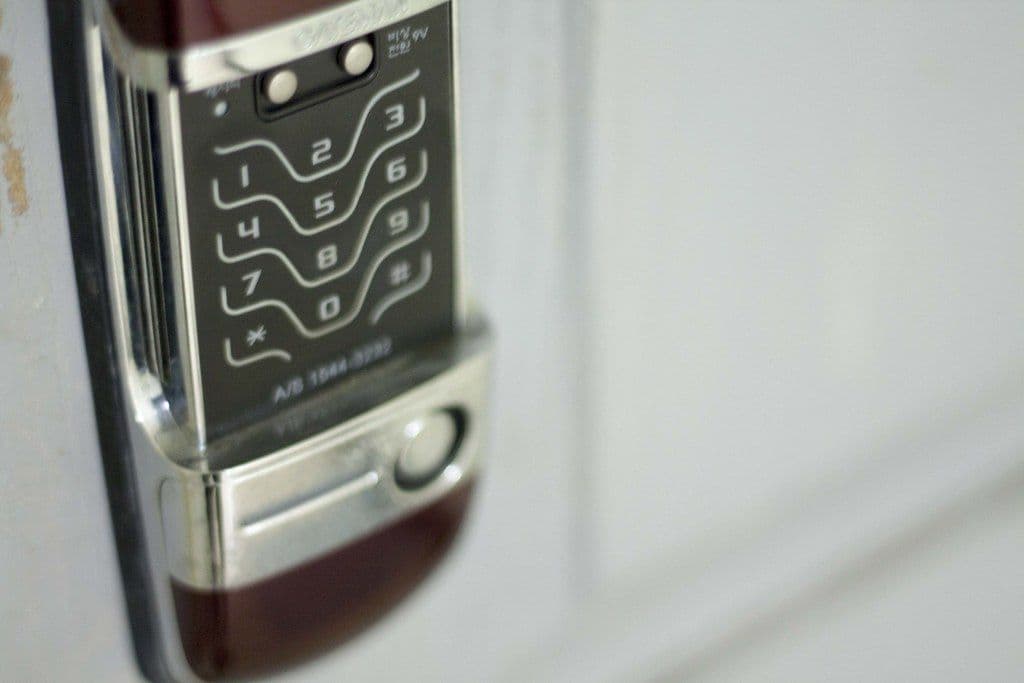
Four beeps and a bolt
Watch someone arrive home in Korea. They walk up to the door, put their hand flat on a panel or tap a short sequence on a keypad, and the door makes a rising four-note chime. Then there is a heavy mechanical sound as a motor drives the bolt back, and the door opens. Nothing came out of a pocket.
Do this a few times and the chime becomes one of the sounds of the country, alongside the subway announcement and the crossing signal. It is the sound of arriving somewhere.
The pocket empties
Keys are one of the three things people check for before leaving a building, and the check is automatic enough that most people cannot say when they learned it. Phone, wallet, keys. A pat on a pocket, usually without looking.
Visitors staying more than a few days describe the check firing and finding nothing, repeatedly, until it stops firing. There is no key. There is a number, and the number is in your head, and your head goes everywhere with you. People report their pockets feeling wrong for a while — lighter in a way that reads as forgetful rather than convenient.
What replaces the old anxiety is a new and different one, and this is the part visitors talk about less. You no longer worry about losing a key; you worry about whether the door locked behind you, because it locks itself and you did not perform the action that normally confirms it. You worry about whether you typed the code where someone could see it. And at some point, usually late, the lock starts emitting a low periodic complaint about its batteries, which is a category of problem no metal key has ever presented.
The other change is social. Because access is a number rather than an object, it can be given to someone over a message in two seconds and taken back the same way. Visitors notice how casually this happens — a code passed to a friend, a cleaner, a delivery, a guest arriving before you get home. Access stops being a physical thing that must be handed over and becomes information, with all the convenience and all the leakage that implies.
Why almost every door has one
The housing stock is young and standardised. Most Koreans live in buildings put up in the last few decades, in apartments whose front doors are steel, of a common thickness, in a common frame, made in an industry that converged on a small number of specifications. When the doors are effectively identical, a retrofit lock becomes a commodity you buy off a shelf and fit in an afternoon. In a country of old, varied, heritage-protected doors, every installation is a bespoke job — and that difference alone explains a great deal of the gap.
Turnover is high and re-keying is instant. Households here move frequently, and the rental system involves large deposits and fixed terms with a lot of churn. Every move-out in a mechanical world means a locksmith, new cylinders and new copies. With a keypad, the outgoing tenant's access ends when someone types a new code. The lock is the same lock; only the secret changes.
Delivery culture assumes shareable access. A country where things arrive at the door constantly benefits enormously from access that can be delegated temporarily. The lock is a piece of infrastructure that the rest of the system leans on.
The price crossed over. Once the digital option became cheap, familiar and stocked everywhere, it stopped being an upgrade and became the default choice, which is why even modest and older buildings have them. Fitting a mechanical lock now is the unusual decision, and unusual decisions cost more.
What this is not
It is not straightforwardly more secure. A keypad shows wear. Fingers leave marks on the four buttons you actually use, which narrows a guess enormously, and this is well enough known that careful people press extra digits before and after the real code. Codes get shared and not changed. Batteries fail, which is why almost all of these locks have an emergency contact point on the underside and why sensible households keep a mechanical override somewhere. The honest framing is that the digital lock is a convenience technology that happens to be roughly as secure as what it replaced, not a security technology.
Nor is it literally universal. Older detached houses, some low-rise buildings, shops, and plenty of interior doors still use keys. "Almost every home" is the accurate phrase and the qualifier is doing real work.
And it is not a sign that Korea trusts technology more than other countries do. It is a sign that the installed base was uniform enough for one product to sweep it. That is a much less interesting explanation, and it is the correct one.
Why it lands as a surprise
The surprise here is unusually pure, because the object being replaced is so old. Keys are one of the small number of physical technologies that survived essentially unchanged from antiquity into the present, and everyone has a lifetime of muscle memory built around them.
So what visitors are reacting to is not a gadget. It is the discovery that a thing they assumed was permanent — a metal object that opens a specific door, carried on the body, lost occasionally, copied at a shop — is in fact contingent, and that an entire country simply stopped using it. Contingency is more startling than novelty. A new invention is easy to file. A missing ancient one is not.
The scale of the reaction, as always, depends on where the visitor is standing when they see it. Someone from a country where digital locks are common on new builds notices the ubiquity rather than the technology. Someone from a city of century-old buildings and stubborn landlords watches a door open without a key and feels something disproportionate, because their baseline was set by a building stock that was already there before they were born, and that baseline was never a choice anyone made.