The café test
Walk into any coffee shop in Seoul on a weekday afternoon and you will see it: a laptop open on the table, a phone beside it, a jacket over the chair back — and no owner anywhere in sight. They are in the bathroom, or outside on a call, or in the queue with their back turned. Nobody is watching the table. Nobody needs to.
Visitors notice this within about three days. It is usually the first thing they mention when someone asks what caught them off guard, and it tends to arrive as a physical sensation before it arrives as a thought — the moment you realise your shoulders have come down, that you stopped doing the thing you do at home without knowing you do it.
The unlearning
Most people arrive with a set of automatic behaviours they never chose deliberately. Bag on the lap rather than the floor. Phone face-down and pocketed between uses. A quick scan of the street before turning into it after dark. Wallet in the front pocket, never the back.
What visitors describe is not learning a new habit but watching an old one become unnecessary. The scan you do before walking down a quiet street stops returning anything. The instinct to move your bag when a stranger sits nearby fires once, twice, and then stops firing. People report a strange few days in the middle of a trip where they catch themselves mid-gesture — reaching to reposition a backpack that was never at risk — and feel slightly foolish.
The second half of that experience is the harder one. Several visitors describe going home and finding the old behaviours do not come back cleanly. You have to reinstall them consciously, and for a week or two you feel exposed in your own city.
Three things that make it work
Cameras, in quantity. Korean cities are heavily covered by CCTV, in public streets, in building lobbies, in lifts, on buses, in car dashcams that are close to standard equipment. This is not one system but many overlapping ones, most of them private. The practical effect for a would-be thief is that a bag snatched from a café table has probably been recorded from four angles before it reaches the door.
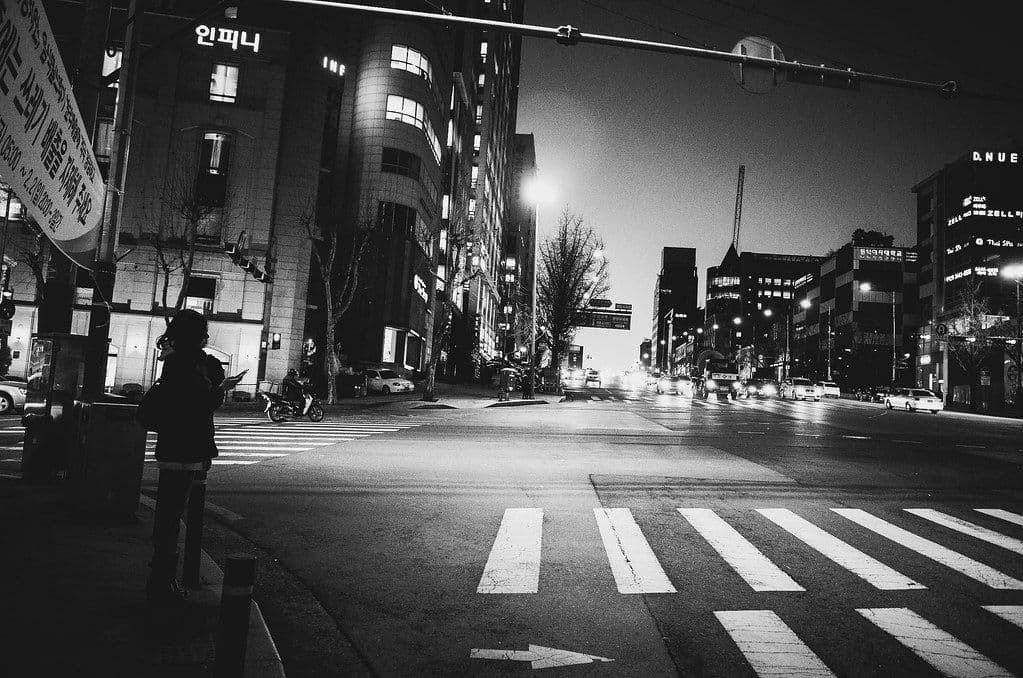
Density, and the eyes that come with it. Korean urban life happens at close quarters and at all hours. A residential street at 1am is not empty — there is a convenience store lit up on the corner, a delivery rider going past, a group leaving a restaurant, someone walking a dog. Streets that would be deserted elsewhere at that hour are simply less busy versions of themselves. Emptiness is what makes a street feel dangerous, and Korean cities produce very little of it.
The arithmetic doesn't work. Stealing a laptop means being recorded, then needing to move a traceable device in a small, well-connected market. The payoff is low and the friction is high. Petty theft is not primarily prevented by morality; it is prevented when it stops being worth the trouble.
Those three reinforce each other. Cameras raise the cost, density raises the chance of being seen, and the low payoff means few people are motivated enough to accept either. Remove any one and the café tables would look different.
What this is not
It would be dishonest to translate "you can leave a laptop on a table" into "nothing bad happens here." Those are different claims, and conflating them does visitors no favours.
Low property crime is the specific thing being described. It does not extend to every category of risk, it is not uniform across every neighbourhood and every hour, and it is not a reason to abandon judgement. People do lose things. Bicycles, in particular, disappear with a regularity that locals find funny given everything else — a running joke holds that a phone left on a table is safer than a bike left locked outside. Umbrellas occupy the same strange category: on a rainy day, the stand by a restaurant door functions less like storage and more like a communal pool, and whichever umbrella you leave in it may not be the one you walk out with. Locals treat both as the two accepted exceptions to the rule, which tells you how solid the rule is everywhere else.
There is also a version of this observation that flatters Korea in a way Koreans themselves would push back on. Ask people who live here and you will get a more complicated answer, one that includes things a two-week visitor does not see. The narrow claim is the honest one: the specific fear of having your things taken, and the specific fear of walking somewhere at night, are both much quieter here than most visitors are used to. That is worth saying plainly, and it is worth not inflating.
Why it lands as a surprise
Here is the part that explains the reaction rather than the fact.
Nothing about a laptop sitting unattended is objectively astonishing. It is astonishing relative to what you expect, and what you expect was set somewhere else, by a city you did not choose and mostly cannot describe. Your baseline is invisible to you until something violates it.
This is why the same street produces completely different reactions from two people standing on it. A visitor from a city where phone snatching is a daily calculation experiences relief that borders on disorientation. A visitor from somewhere already quiet notices very little and wonders what the fuss is about. Neither is wrong. They are measuring against different zeros.
It also explains why this particular surprise is so often the one people lead with. Most travel surprises are additive — a food you had not tried, a custom you had not seen. This one is subtractive. Something you carry everywhere gets put down, and you feel the weight of it only in its absence. Subtraction is harder to anticipate than addition, which is exactly why it lands.