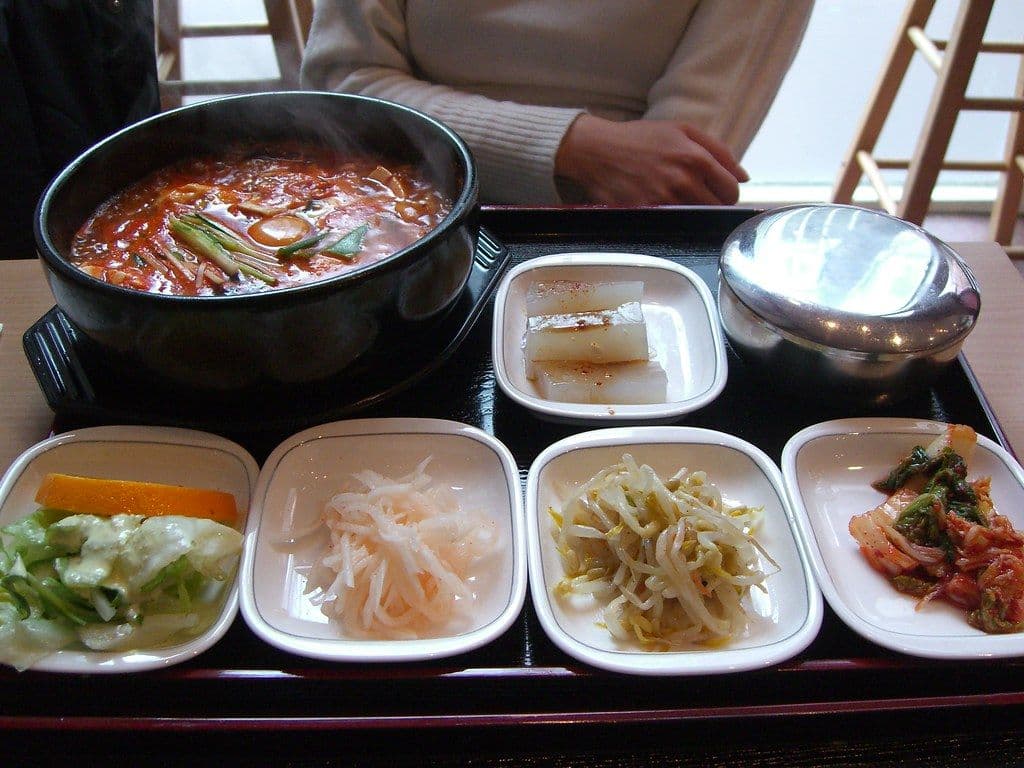
Six plates you did not order
You order one thing. A stew, say, or a grilled fish. Before it arrives, the table fills up: kimchi, of course, but also seasoned bean sprouts, a small pile of braised potatoes, a dish of pickled radish, some cold spinach, a fried egg pancake cut into strips. Six or seven small plates, none of them on the bill, none of them mentioned when you ordered.
Then you finish the bean sprouts, and someone takes the empty dish away and brings a full one.
Learning to read the table
The first reaction is almost always a mild panic about whether this is a mistake. It is not. The second is arithmetic — the suspicion that these must be appearing on the bill somewhere. They are not, in the sense that no line will name them.
What takes longer is the change in how you read a menu. Visitors arrive with the assumption that the menu describes the meal, and that ordering one dish gets you one dish. Here the ordered dish is closer to the centrepiece of an arrangement that the restaurant has already decided on. You are not assembling a meal from components. You are choosing which meal to be given.
This has practical consequences that people work out by trial and error. Ordering four dishes for four people produces a table that cannot physically hold the food. Ordering one dish and sharing it is often entirely reasonable. And the correct response to an empty side dish is not to leave it empty but to ask, which visitors are strangely reluctant to do for the first several days, because asking for more free food violates something they were raised with.
There is also the matter of what the plates tell you. Regulars judge a restaurant by them. A place with good banchan is signalling that its kitchen has depth and that someone was in early doing prep. A place with three tired plates is signalling the opposite. The side dishes are, among other things, a review of the restaurant written by the restaurant.
Why it is possible
The meal is structured differently. In the Korean model, the base unit is rice and soup with banchan around it, and the dish you ordered joins that structure rather than replacing it. The side dishes are not a bonus attached to your order; your order is an addition to a table that would otherwise still be a meal. Once you see the arrangement that way, the free plates stop looking like generosity and start looking like the frame.
Banchan are built for this. Most are pickled, fermented, blanched or braised — made in quantity, in advance, and stable for days. They are cheap per serving, they do not require a cook's attention at the moment of service, and they improve rather than spoil while they wait. A cuisine of fermentation can afford to give food away in a way that a cuisine of à la minute cooking cannot.
It is competitive signalling. A small restaurant serving one or two main dishes cannot easily differentiate on its menu. It can differentiate on what surrounds the menu. Banchan is the cheapest available axis of competition and the most visible, which is why the plates keep appearing even though nobody is obliged to serve them.
And it is priced in. The cost sits inside the price of the dish you ordered, spread across every customer. This is the ordinary economics of anything described as free — the restaurant has calculated a per-head cost and set the menu accordingly, and refills are viable because most people do not ask for many.
What this is not
It is not free in any economic sense, and the word does more work in English than the situation supports. You are paying for the banchan. What is unusual is not the absence of a cost but the absence of a decision — you were never given the option to decline them and pay less.
Refills are not unlimited in practice. They are unlimited in spirit at most places and finite in practice everywhere, and asking for a fourth round of the expensive one will be noticed. There is also a strong local dislike of waste, which is felt more sharply here than the abundance of the table suggests: taking a full refill and leaving it is worse manners than not asking.
The variation is enormous, too. A cheap lunch place, a regional specialist, a seafood restaurant on the coast and a franchise chain outlet all handle this differently, and the version with a dozen plates is a particular kind of restaurant rather than the national default. Hygiene rules and changing attitudes have also pushed most places away from reusing untouched plates between tables, which is a change locals remember happening.
Why it lands as a surprise
The surprise is not abundance. Plenty of countries put bread on the table, or olives, or crisps with a drink, and visitors from those places are not shocked by the existence of something uncharged.
What is unusual is the ratio and the unrequestedness together. Something arrives that you did not choose, in a quantity that is not a gesture, and it keeps arriving as long as you want it to. That combination breaks the transactional model of a restaurant meal that most visitors carry without knowing they carry it — the model where the bill is a list of things you asked for and each one has a price.
So the reaction is often mildly uncomfortable before it becomes pleasant. People feel they owe something. They over-thank. They eat side dishes they do not want out of a sense that leaving them would be rude. Most of this is the visitor's own accounting instinct running with nothing to account for.
And the size of the reaction depends entirely on the table each person grew up at. Someone from a food culture with its own tradition of small shared plates registers this as a variation on a theme. Someone from a culture where every item on the table was individually purchased finds the whole arrangement quietly destabilising. The plates are the same plates. The zero is not the same zero.