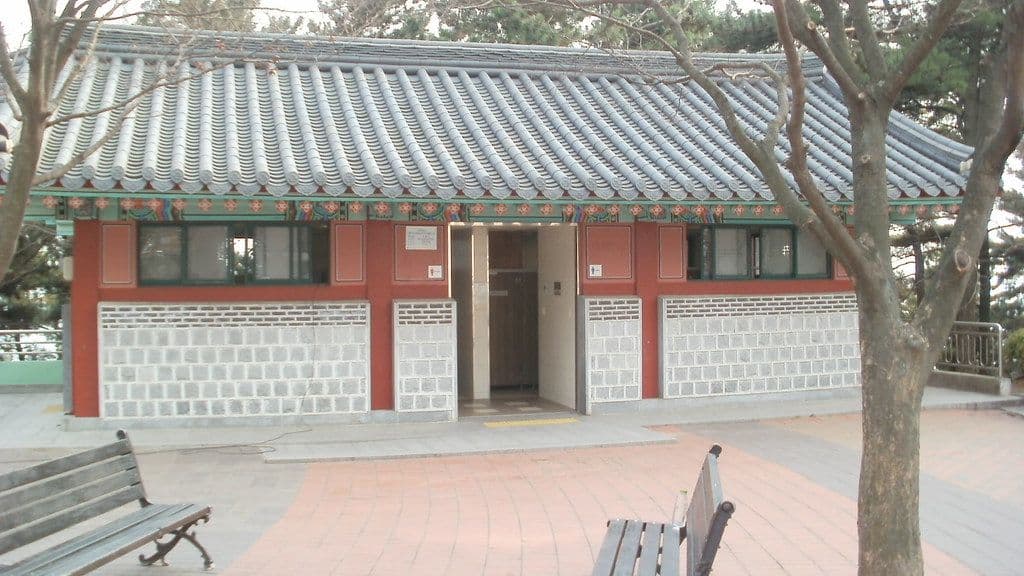
The sign that means what it says
In a Korean subway station there is a sign with an arrow and two pictograms, and if you follow it you arrive at a public toilet. There is no turnstile. There is no attendant with a saucer of coins. There is no code printed on a receipt you would have had to buy something to obtain. There is a cleaning schedule on the wall with the last few checks initialled, and a floor that is dry.
Sit down and the seat is warm, because it is heated, and there is a small control panel on the side of it offering a bidet function that most visitors will look at for some seconds before deciding what to do.
The calculation that stops running
Everyone from a city with poor public facilities runs a background calculation, and like most background calculations they cannot describe it until it stops.
It goes: where is the next one, how long until I need it, what will it cost, do I need to buy a coffee to get access, is that place open, is it the kind of place I would use. It shapes routes. It shapes how much water people drink. It shapes what parents with small children are willing to do with an afternoon. It is one of the quiet ways a city is easier or harder to be in, and it is almost never discussed.
In Korean cities the calculation stops returning anything useful, because the answer is nearly always "in the station, or the department store, or the park, or the underground shopping level, and it is free." Visitors describe a specific loosening that follows — longer walks, more coffee, less planning. Parents describe it more emphatically than anyone.
The heated seat produces a different reaction, more comic than practical. In winter it registers as an almost embarrassing kindness. The bidet panel produces caution first, then, for a good number of people, conversion, followed by a slightly awkward period after returning home.
Why they are like this
Public buildings are treated as genuinely public. Stations, government offices, department stores, large shops and the vast underground shopping levels beneath many cities all provide facilities that anyone can walk into without buying anything. The norm is that a building open to the public includes a toilet open to the public, and no one polices the boundary. That single norm does most of the work here.
Provision is regulated rather than voluntary. Buildings and facilities of certain types are required to provide public-access toilets and to maintain them, which turns a courtesy into an obligation with an inspection attached. Voluntary provision produces the pattern most countries have — a few good ones, many locked ones. Required provision produces density.
Cleaning is continuous and staffed. The checklists on the wall are not decorative. Facilities in busy locations are cleaned repeatedly through the day rather than once overnight, which is a labour cost, and it is the difference between clean at 7am and clean at 6pm.
The heated seat arrived from the home, not from the state. Korean bathrooms are small, often unheated and frequently cold in winter, and heated seats and bidet units became a normal domestic purchase — cheap, mass-produced, widely available. Once the fitting is standard in homes, specifying it in a public building is unremarkable rather than luxurious.
What this is not
The variance is much larger than the summary suggests, and visitors who generalise from a new subway station will be caught out. An old market building, a small park at the edge of a city, a mountain trailhead, a bus terminal in a smaller town — these are a different experience, sometimes considerably. Squat toilets still exist and are entirely normal in older facilities.
There are practical quirks that catch people. Paper is sometimes dispensed at the entrance rather than in the stall, so you take what you need before you commit. Some cubicles ask you to put used paper in a bin rather than flush it, particularly in older plumbing. Some facilities in commercial buildings do use a code, usually posted or given at the counter. And soap and hand-drying are less reliable than the toilets themselves.
There is also something a candid account has to include: hidden-camera crime in public and semi-public toilets has been a serious and widely covered issue in Korea, and it is the reason for the inspection stickers you will see on cubicle walls and for a wariness among Korean women that a visitor praising the facilities may not be aware of. The toilets are clean and free. That is a narrow claim, and stretching it into a claim about how safe they feel to everyone using them would be inaccurate.
Why it lands as a surprise
This is the item most likely to embarrass the person describing it, which is part of why it lands. Nobody plans a trip around toilets. Nobody expects them to be memorable. And yet visitors from certain cities bring it up unprompted, slightly apologetically, because the relief is real.
The reason is that toilet access is a pure baseline phenomenon. It is invisible when it works and constant when it does not, and almost nobody examines their own assumptions about it. Someone from a city of paid turnstiles and customers-only doors has spent years adapting to scarcity without ever naming it as scarcity. Take the constraint away and what surfaces is not admiration for plumbing but the odd sensation of a rule you did not know you were obeying being switched off.
Which is why this item splits visitors more sharply than almost any other. A visitor from a country with abundant, free, well-kept public facilities notices the heated seat and nothing else, and genuinely cannot see why anyone would put this on a list. A visitor from a city where the answer to "where can I go" is a real problem finds it one of the most useful things about being here. They are describing the same room. Their zeros are nowhere near each other.